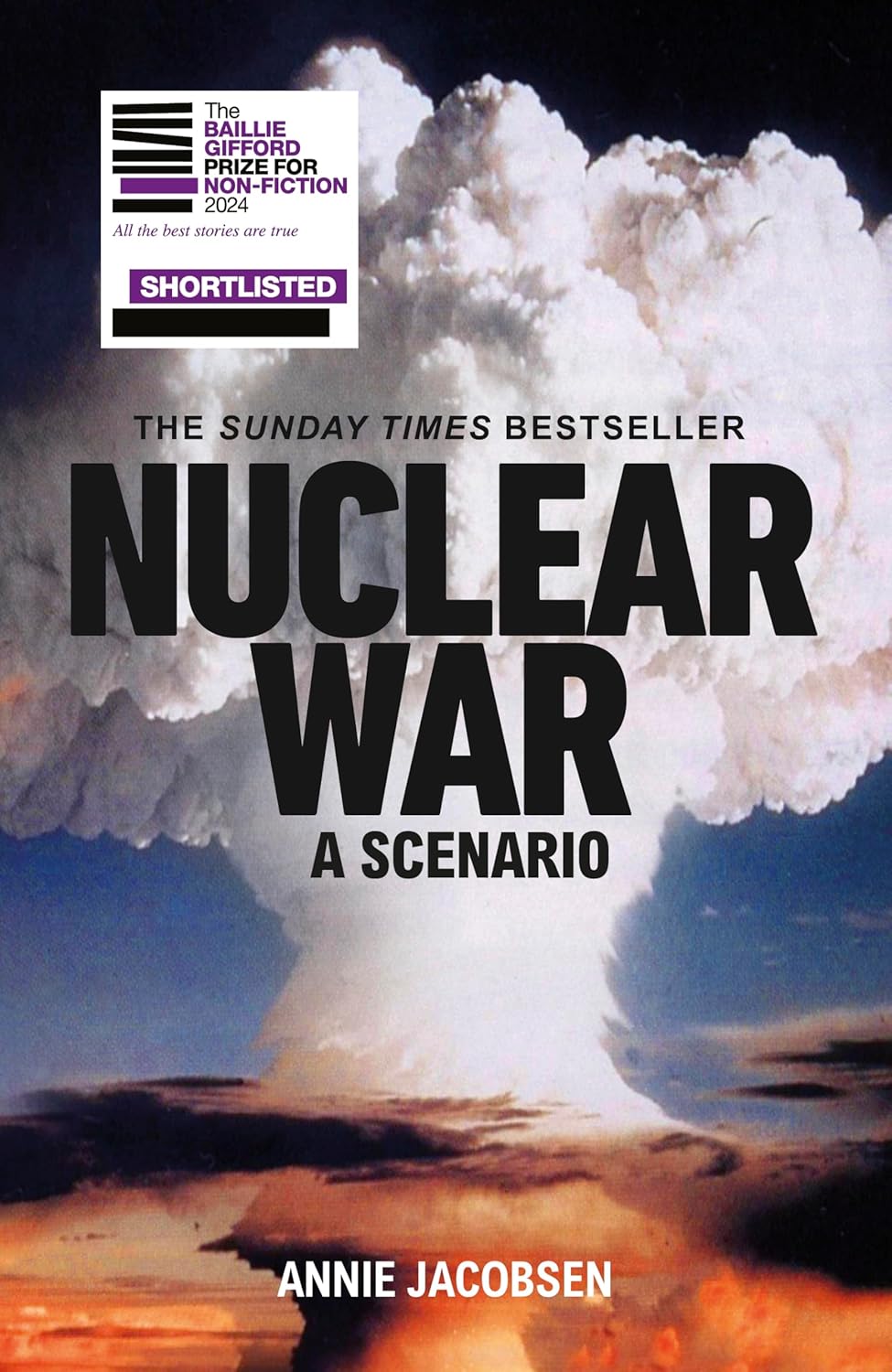
Nuclear War: A Scenario (2024) by Annie Jacobsen is an important book and a riveting read. But that is just one of the reasons why it should be read.
As the title suggests, it lays out in painstaking and graphic detail a scenario of a nuclear war triggered by the launch of a nuclear warhead targeting the US, by none other than one of the infamous villains of the West—the North Koreans—and what unfolds at multiple levels of government, the military and internationally, on the one hand, and the moral, human consequences on the other.
One thing becomes clear: once a nuclear-tipped missile is launched, there is no going back. It is likely to set off a sequence that culminates in mutually assured destruction—a description you realise is utterly bald and boring once you race through Jacobsen’s detailing of the aftermath.
The arms race, nuclear deterrence (and the collapse of rules and reason once deterrence fails), the launch sites, the surveillance infrastructure (the ‘eyes’ in the sky and space for early warning), and the elaborate protocols and redundancies that are in place to prevent mishaps are spelt out in detail, staggering and scary at the same time. All this leaves one feeling vulnerable, fragile and utterly at the mercy of faceless, powerful people (or madmen) in a chain of command that ultimately responds to human, subjective assessments of who must survive and who (and how many—how many hundreds of thousands) are expendable in this chain of events.
The science of destructive power and delivery systems, and the calculus of who and how many must die in a nuclear exchange is well researched and the competitive picture of who has more nuclear warheads makes for sober reading since this is a race that assures mankind’s annihilation rather than advancement.
In pages that are not for the faint-hearted, the book describes in detail the initial few seconds and minutes after a nuclear strike—the instant vaporisation of people and structures, the destruction, and the laying to waste of vast tracts of land and habitation—and the longer-term deadly and agonising consequences for people who survive.
It bothers me when nuclear threats are brandished causally, passions are roused, and governments are goaded by jingoistic sentiments to consider the nuclear option or when people are misled by the idea of a limited nuclear war. One always hopes for voices of sanity and a recourse to dialogue and negotiation even in the event of existential threats to one’s nation rather than reaching for a ‘final solution’.
Jacobsen’s book is an output of deep research. The scenario it elaborates is plausible and is therefore particularly chilling. The book is a timely reminder that in a nuclear exchange there are no winners, as it will unleash a cascading chain of events that grabs in its fold multiple nuclear powers, all armed and ready. A nuclear armageddon followed by a nuclear winter for millennia, and an earth left ravaged and uninhabitable.
A famous quote says, ‘War does not determine who is right, only who is left.’ Jacobsen leaves us in no doubt that if nuclear war breaks out, there will be no one left. Even to argue about who was right.
Leave a reply