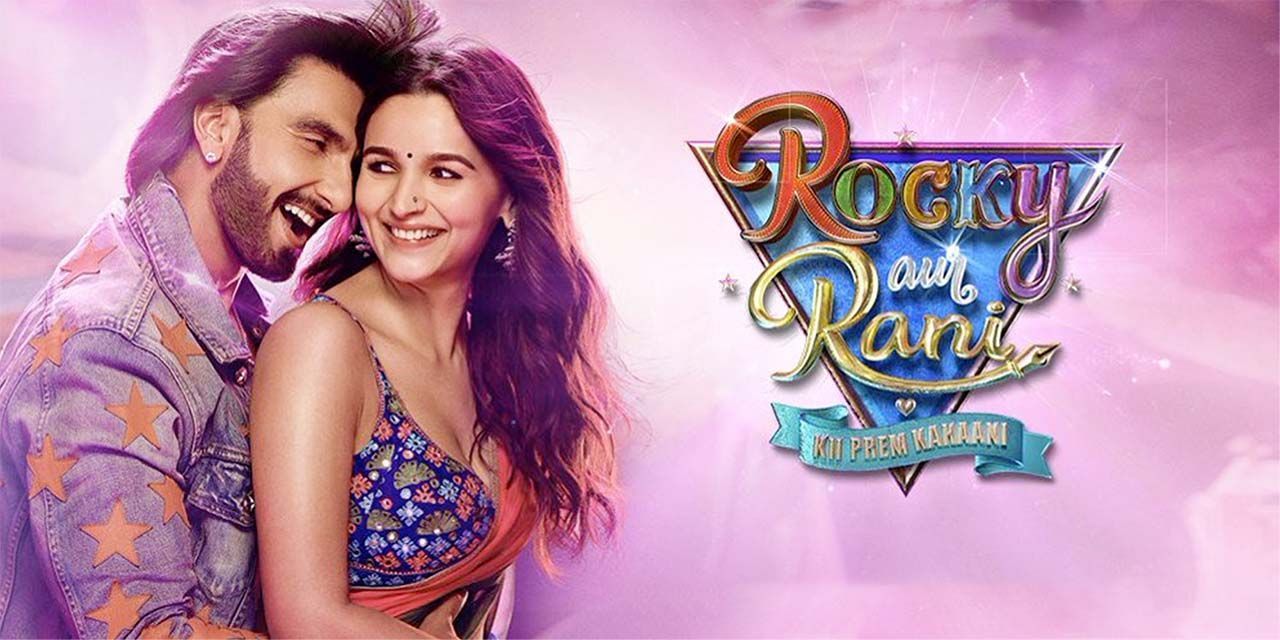
The Short of It
- I had a great time watching the film.
- I laughed—loudly, and a lot.
- The storyline was same old, same old.
- It also offered something to think about—same old, but one more time.
- Ranveer Singh was terrific.
- Alia Bhatt is very good. My first Alia film.
- Dharmendra was a good choice. Shabana Azmi was so-so. Their strand had potential for a separate movie. After a point the premise, the setting and the scenes made me cringe.
- I liked the juxtaposition of the oldies romancing against the blossoming youthful love.
- Some scenes and messaging felt contrived; don’t remember which now.
- Left to me, I would have chopped about 30 min.
- Will I watch it again. Of course. At least once.
The Loooong of It
(With digressions to indulge my need for profundity and intellectualisation. You have been warned!)
After quite a while, I watched a film where it wasn’t hard to follow the story or guess what was coming. It was a laugh riot—my friend and I were found guffawing loudly every now and then. There was a lone viewer who cheered lustily when punchlines were thrown by the female protagonist—lines that spoke for the modern woman, her aspirations and her stances on love and life, and her unwillingness to yield to the demands of tradition.
The film tries to score several points along the way. One was about political correctness and the difficulty of using language that could cause offence by today’s standards. I was reminded of George Carlin’s piece on soft language.
In terms of emotional demand, there were three main strands:
The Love Story of Alia and Ranveer
Alia Bhatt’s character, a successful news presenter from a cerebral and artistically inclined, sophisticated family, and Ranveer Singh’s character, in line to inherit a successful family-owned business, from a context steeped in tradition, and more earthy, conservative and ritualistic. Will great chemistry between them mature into deep love?: that is the question. And, of course, no marks for guessing. It starts with frivolous fun, gets serious after the usual doubts, and then is the trial by fire that they must endure to win over the family of the opposite number who are opposed to the alliance. This sets up a clash of cultures that eventually ends with reconciliation, forgiveness and acceptance. The basic plot line of lovebirds who hail from different backgrounds choosing to win over each other’s parents reminded me of Saudagar (1991) with Dilip Kumar and Raaj Kumar.
Along the way, Alia manages to champion agency for women in the boyfriend’s family, evoke self-belief and show them to value themselves for who they are rather than as mute, conforming familial props. Ranveer learns to step out of a life of privilege, enters Alia’s household, and comes to terms with his simplicity and his unsophisticated self, adds humility, and also discovers that his whole life has been in captivity—confined by set ways of being and relating as a family, marked by the bestowal of privilege to him as a male (within and outside the home) but also a lack of affection and touch.
In the given social order women have it harder. They must make their case to not be dealt with as property and against their objectification. They must show up the inequities of power, resources, access and even affections without being labelled haughty, quarrelsome or meddlesome.
The elements seem stacked against them. In the film, Ranveer already has Alia’s mother (Shabana Azmi) in his corner—the elder with a benign presence and a place and a voice in the household. Alia on the other hand is in alien territory with the memory-challenged and physically impaired elder who receives care but not love and who cannot actively advocate for her inclusion.
Love: Second Innings
This deals with the embers of a love long buried, now lighting up between an elderly man (Dharmendra), Ranveer’s grandfather, and an ageing woman (Shabana), Alia’s grandmother. They shared a deep bond years ago but chose a life apart, staying wedded to their spouses. One gathers that both were in loveless marriages—one in an abusive household and the other where there was no respect. By a quirk of circumstance, and with help from the lead pair, two generations younger, they rediscover each other in the evening of their lives. What follows is the rekindling of a long-abandoned fleeting romance alongside the fledgling love between our youthful leads.
While I endorse ‘age-no-bar’ in love, the treatment of their reunion was cute and comic but cringeworthy beyond a point. It was a sideshow that lingered way too long. What was the cringe about? I don’t quite know yet. The question stayed on…
The search for connection, love and acceptance, to feel alive, to be celebrated, to feel one’s heart soar and to suffer the pain of separation is, to my mind, universal. It is day-to-day, and across the vastness of time. It is a seed that doesn’t self-destruct no matter the inhospitable conditions of socialisation, the taboos, injunctions and fears (of censure and rejection). We are the victims of self-sabotage and countless compromises, painted with the gloss of responsibility, honour, respect, fidelity and duty. What survives is only the lie that one can love only one, and all that is worthwhile must be found within the institution of marriage.
If unlucky with a love of joyous discovery and celebration of the totality of the other (whatever be reasons for not allowing its due course), one endures existence as a pale shadow of all that is enlivening through a carefully constructed equilibrium with one’s context and an insurance against a life of social awkwardness and loneliness. A huge price to pay for giving up something prized.
What is illicit, illegitimate love really? If it is love, would we think of it as ugly, irresponsible, promiscuous, morally flawed? Perhaps not. The call of the being, a soul’s yearning and love’s reach is not circumscribed by social mores. Labelling creates difficulties and enforces a kind of self-censorship, a shutting of possibilities, a wilting away of the part of the self that seeks aliveness, tenderness and nourishment.
The Clash of Families and the Clash with Tradition
Is a meeting of minds the gatekeeper to the meeting of hearts? Is the approval/acquiescence of family so critical as to wager love for acceptance?
The movie invests a significant amount of time on this. After all, the boy is not welcome in the girl’s family and vice versa, but apparently, family acceptance is a prerequisite for their romance to transform and graduate to a marriage. Each simultaneously undertakes to spend three months in the other’s household to check things out and work their way to the elders’ approval.
Those who embody family tradition typically are portrayed as inflexible, fiercely protective of their inherited way of life, and allowing for limited space for autonomy, inquiry and challenge. The male scion is favoured and has special privileges while the women get a raw deal, reduced to a life of servitude and limited familial roles. Expression is restricted, talents and desires are kept under wraps, terror rules to enforce obedience, and love is invisible, an assumed commodity. Boundaries are tightly held; one cannot be allowed to stray. Honour is codified and violations invite violence of various kinds.
It seems hard to ignore family approval. It is hard for me to understand wilfully erected hurdles arising from prejudice (and unnamed fear) in the family towards well-meaning overtures and penance of the love-struck.
Tyranny, control and cunning disguised as tradition keeps a family in check. Till the cracks begin to appear, allowing the light to come in (thank you, Cohen). The edifice of tradition that doesn’t allow the light, breeze, sounds and smells of the present times—a reinterpretation, or an adding to—will become putrid, and die. We saw a family tether on this edge.
What creates this wall, this veil, this seemingly impenetrable boundary? It would be interesting to ask ourselves what is the worst in us that we (as individuals and families) seek to hide and what is the worst we imagine in others that we feel threatened by? Likewise, what is the best in us that we seek to protect and what is the best in others we fear as superior in comparison and shows us falling short?
So, shame and arrogance, pride and smallness, contempt and fear.
Broad Strokes
I was watching Alia Bhatt for the first time. She had beautiful presence, an ease about her that communicated authenticity, and the ability to emote without strain. Ranveer was all testosterone, effervescence and charm, that sometimes distracted from the terrific actor he was, blessed with great timing. Jaya Bachchan reminded me of Amitabh Bachchan in Mohabbatein (2000), the stern, unsentimental and perhaps even unfeeling and upright patriarch. I thought Dharmendra did a great job, but I can’t say the same of Shabana.
The use of old, popular film songs was smart touch that I loved. They meshed well with the sequences and added to the lighter moments. The director may have missed a couple of numbers that could have fitted well: ‘Pyar kiya to darna kya’ and ‘Khullam khulla pyar karenge’ came to mind.
I thought the film could have been shorter by 30 minutes. I did find myself waiting for the intermission, looking at the watch and my phone messages a couple of times. The storyline, as I’ve said, was rather predictable. The songs and the extravagant sets didn’t hold my interest—they were over the top and not memorable. The soundtrack reminded me of the family melodramas churned out by Ekta Kapoor for television—forgettable.
All in all, the movie felt familiar, with known formulae and a sprinkling of change—much like software after the latest update.
Leave a reply