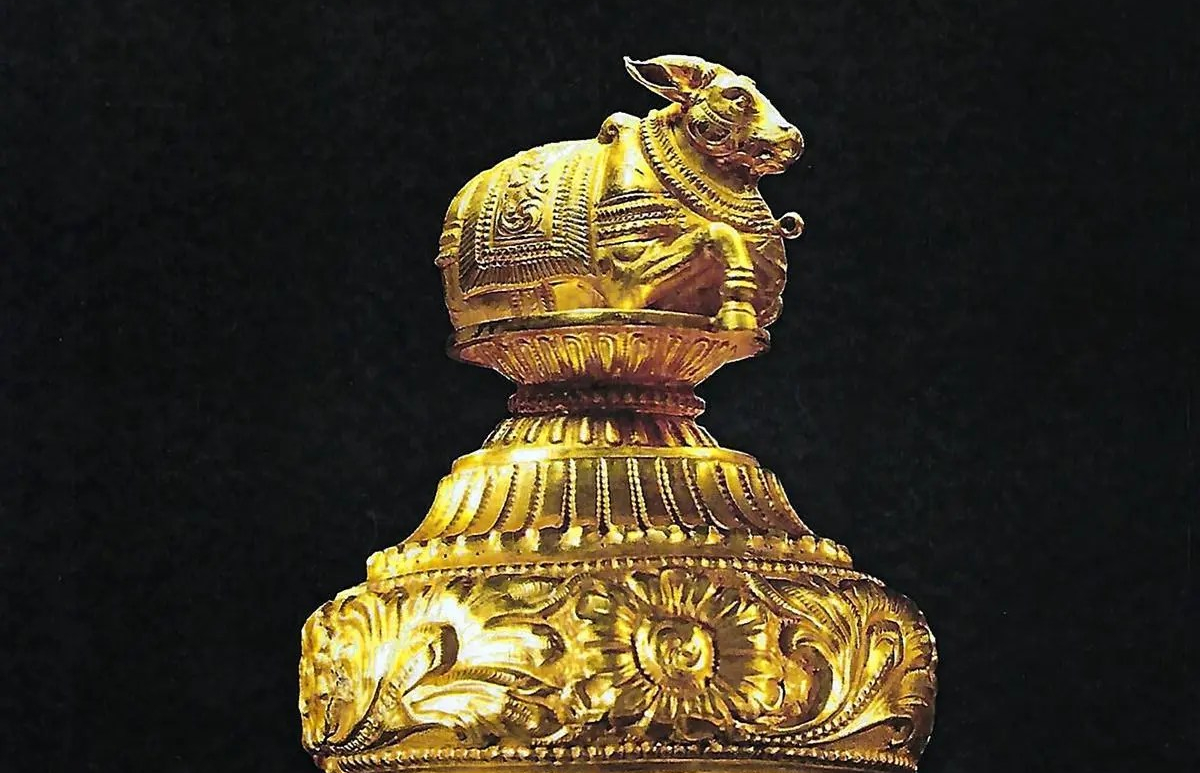
The Sengol’s journey to the new Parliament building and its installation there, far from signalling a new era, giving back power to the people, taking another step towards decolonisation or bolstering pride in our traditions, turned out to be a cringe-fest and a multimedia extravaganza intended to prop up the waning fortunes of one man who craves the spotlight, arranges himself at all times to be lens-ready and whose bombast on the radio waves thrusts an alternate reality presumably to dull the pain of the present.
The country woke up to the existence and significance of the Sengol just a week ago and soon enough it was apparent that the facts and circumstances surrounding its role in the transition of power at the time of Independence has not been adequately and accurately documented. So, stories abound. This has not stopped the ruling party, ever ready to embrace a version it finds convenient to vilify the first prime minister, from bringing it back into the public arena and imbuing it with symbolism that is rich, but ultimately self-serving.
The inauguration became an occasion to flaunt the ruling party and its government’s adoption of Hindu ritual, and the coming together of the political and the religious—a long nursed desire. Constitutional niceties were sacrificed, spectacle overwhelmed substance, piety lost to pomp, other faiths were left out without a token mention, and grave events in the country that craved urgent attention were shut out or postponed for another day. While the Sengol’s symbolic significance has captured the airwaves and the public’s attention these past few days, the portents of what was on display during the inauguration will be analysed with unconcealed joy by some and utmost dread by others.
There is a way to energise by constantly excavating real or imagined wrongs of the past, the slights and hurts. When as a people this process is encouraged, when division and hate for the Other is fanned, what follows is vengeful cyclical bloodletting, not healing. The recent years have normalised this, and indeed has become part of political gamesmanship. The appearance of the Sengol currently is part of this.
Symbols help to stoke, evoke, and provoke. They serve as a useful distraction too. Too much is being foisted on a symbol, hoping that it will do the work of preserving, promoting, and prospering as a nation. It is one thing to reclaim one’s past and quite another to recreate it, to take pride in it rather than to treat it as a refuge, to take inspiration from it and not use it to invoke a future that starts from an unwholesome criticism of the present.
People who celebrate the Sengol’s march to Parliament as some act of restoring Dharma and democratic ideals, and of giving back power to the people, choose to remain blind and silent about the rampant cult of personality very much ‘in your face’ right here, right now. It is surprising too that we choose not to see how much the spirit of democracy has been eroded and abetted by the silenced or co-opted media.
Shorn of all ceremony, it is about vacating a building and moving to another. All the chatter about the ‘transfer of power’ and the hyped ritual surrounding it is utterly irrelevant. The Sengol is a manufactured item of commentary, craftily inserted to enthuse and agitate, hold people in a thrall but stay uninformed, and stay malleable to demagoguery.
One wonders how the new building will turn out—as a temple of democracy or doom?—though reading the signs of the programmed, assisted degeneration of all institutions and governance in the recent years, the new building might turn out to be a memorial to remember Parliament by, rather than as a live assembly of the finest patriots.
What is the nationhood that we imagine? How is anything we encounter today in line with it?
Image: PTI


Leave a reply