I don’t remember when I stopped enjoying the rains. It has little to do with the early memory of being stranded with my sister and grandmother for close to twelve hours in a first-class train compartment near Trichy; the railway track across the river just ahead had been engulfed by the swollen waters. I was probably 3 or 4 years old. I remember that it added to my sense of being alone and increased my fears of being abandoned.
In the following years, I did most of the stuff that children usually do – look out of the windows for hours and watch the lashing rains come down, and sometimes go out, get drenched. The trees and branches would give up trying to shrug off the shower after the initial gust of wind ceased, and would then stay limp, soaked, and dripping from the assault. It was a mystery to me that trees continued to rain long after the rains stopped, clouds dispersed, and the sun came out. My friends and I would jump into puddles or leap across them, a different challenge each time. It was fun tossing stones into the pools of water on the roads. The nights after the rains were unusually noisy, with countless frogs and crickets, and it was always a wonder that such small creatures could team up and pierce the quiet of night for hours.
Once, in Gorakhpur when in the seventh grade, during the monsoon, the rains were so heavy that my school closed for the day abruptly before lunch. My sister and I waited for the rains to abate but soon found that most others had already left. So, we left too. Halfway home, cycling against strong winds and heavy rain, I was suddenly thrown off my bicycle by a crack of thunder so loud that I was stunned for a couple of minutes. Confused and embarrassed, I collected myself and the bicycle, mumbled something to my sister and we raced home together. My mother was relieved to see us back home. She took us to the window and pointed to the banana tree in the garden. Charred. Struck by lightning. For me, that explained the piercing thunder. I told myself that I had gotten away lightly falling off the bicycle, imagining the dramatic end that a bolt of lightning might have dealt.
I was used to intense rain that would go on for hours, even days, in Chennai. They were caused by cyclones during the winter months. They dumped a huge amount of rain, and our water security during summer months depended on it. We were used to the rain gods disappointing us too. I remember one summer, we depended on railway tankers bringing water from Vijayawada; it was a novel idea and a desperate situation. Another time many years later, the summer following a failed monsoon meant peering into the well to check for water, hoping it hadn’t dried up.
I was in Delhi when I started my career. My job took me to Chennai a few times. One monsoon, I was all set to leave home quite early, at about five, to take my 6:50 am flight to Delhi. My travel allowance covered my auto-rickshaw fare and knowing Chennai rises early, felt confident. I stepped out to fetch transport and just then, it started to pour. The rain was so intense that the roads were deserted, and it seemed that the rising sun decided to retreat. Visibility was poor and the umbrella was of no help. Eventually, I managed to reach the airport, only to be told that the boarding gates were closed, and I could try and re-book for a later flight. The rains then stopped, and the orange of the morning sun spread across the sky. It was impossible to convince the airline that I was indeed stranded due to the rain. He simply shrugged his shoulders, told me that the flight was taking off nearly full and after that, I ceased to exist to him. I had to forego a big part of my earnings for that month to buy another ticket – all because the Rain Gods unleashed an hour of unstoppable fury.
Chennai’s cyclonic weather conditions of November also set the stage for Chandrika’s first visit to our home in Chennai, in 1988. Chandrika and I had decided to marry a few months earlier, and we had travelled to Chennai so she could meet the family. I recall that it was a rather rain-soaked first visit. We were confined to the house on most days. The house was a mess as it often is when the sun is not out for days – the clothes hang around, and people hang around too, everything is damp, leaks spring in unforeseen places adding to the misery, and barring the chai-pakoda everything can get to be a bit much. My sister and her infant daughter were there too. With her, came baby-paraphernalia – bibs, nappies, toys and other such, adding to the general sense of disarray. We all made our weak apologies for the mess. I later learnt that the week she spent with us in Chennai cleared any residual questions and doubts about her decision to marry. We were just ourselves and she felt received, and could just be without the pressure to be this or that, to impress and make an impact.
So, the rains hold many stories.
Here is another. This one is set in Ahmedabad. I had taken up an assignment there one June and was new to the city. Ahmedabad in summer was dry and searing hot, dusty and polluted. As luck would have it, we had a bountiful monsoon. The city was ill-equipped to cope. I had a Maruti 800 that I used to drive to work – a distance of maybe 8 to 10 kms.
Driving through the water-logged roads was challenging. One morning’s drive proved to be nearly beyond me. It had rained rather heavily through the night and did not let-up in the morning. The road outside the Corporate office was waterlogged, I heard. I received mixed messages – one said to assemble at one of our factories from where we would travel by truck to the office, while another said that cars had managed to get into the office premises. I decided to brave the road conditions.
The last half-kilometre seemed near impossible. Water on the roads was nearly as high as the car windows. It had begun to seep into the car and my ankles were getting soaked. Anytime a bus went past, my car would bob up and down. Steering the car, getting it to turn into the office against the pressure of the river-like conditions was proving difficult. There were vehicles in front and people wading through the water to push the ones that had stalled, that one had to avoid. All the while, I inched my way forward hoping that my car wouldn’t stall. Miraculously, it worked its way forward. I can’t remember my heart ever beating faster than on that morning. When I reached the parking lot and stepped out of the car, water spilled out. It took me a few minutes to collect myself. It was probably the only time I spent the day in office barefoot. The car took two whole weeks to dry!
Every year’s monsoon is marked by stories such as these.
As years have gone by, my ease with the rains has diminished. Unlike Chandrika and Meghna who loved their walks in the rain, I prefer the shelter. I love watching how the rains can tease, threaten and take over. The rains sustain life and take some too. It has given Indian films poetry, song, and dance… and for people, their dreams.
While the rains evoke a sense of romance, in recent years, it has been accompanied by a sense of dread. The 2015 floods in Chennai were unforgettable. The rains were unrelenting. The city came to a standstill. The deluge was upon us. Everyone, without exception, had a story to tell – of loss, destruction, disruption and death. There were stories too of heroism, solidarity and kindness.
Our increasing sophistication and accuracy in weather forecasting models are cold comfort in the face of the growing severity of monsoon events. The rains have repeatedly come knocking asking for a fundamental re-architecting of a vision for our towns and cities and a reminder that the good of all cannot be reconciled with the greed of a few, that Nature is the master, and mastery over Nature is a fool’s pursuit.
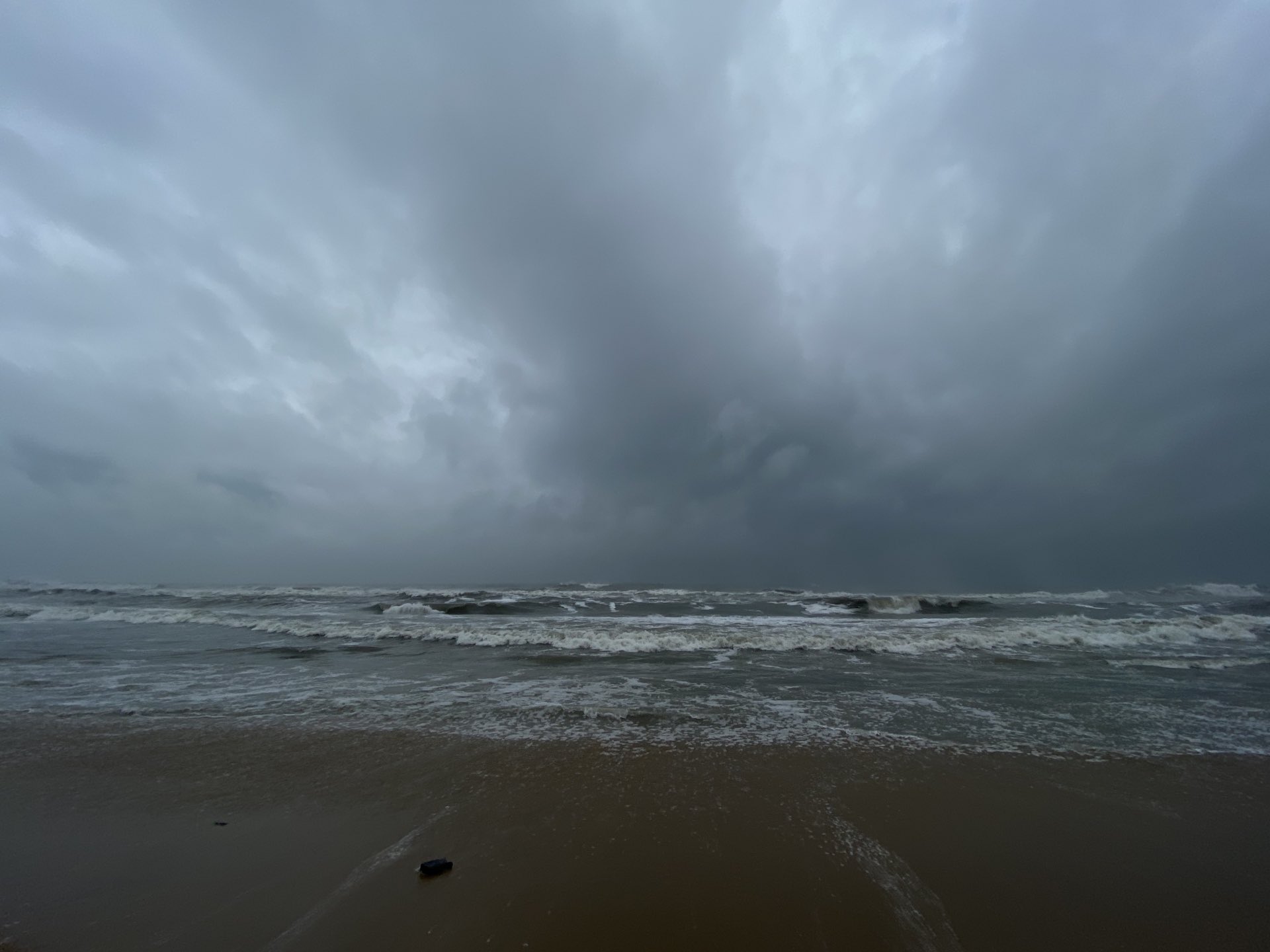
Image taken by my friend, Mohan Ranganathan (via Twitter): The sea off East Coast Road, Chennai during the approach of Cyclone Nivar, 25th Nov 2020.
Leave a reply