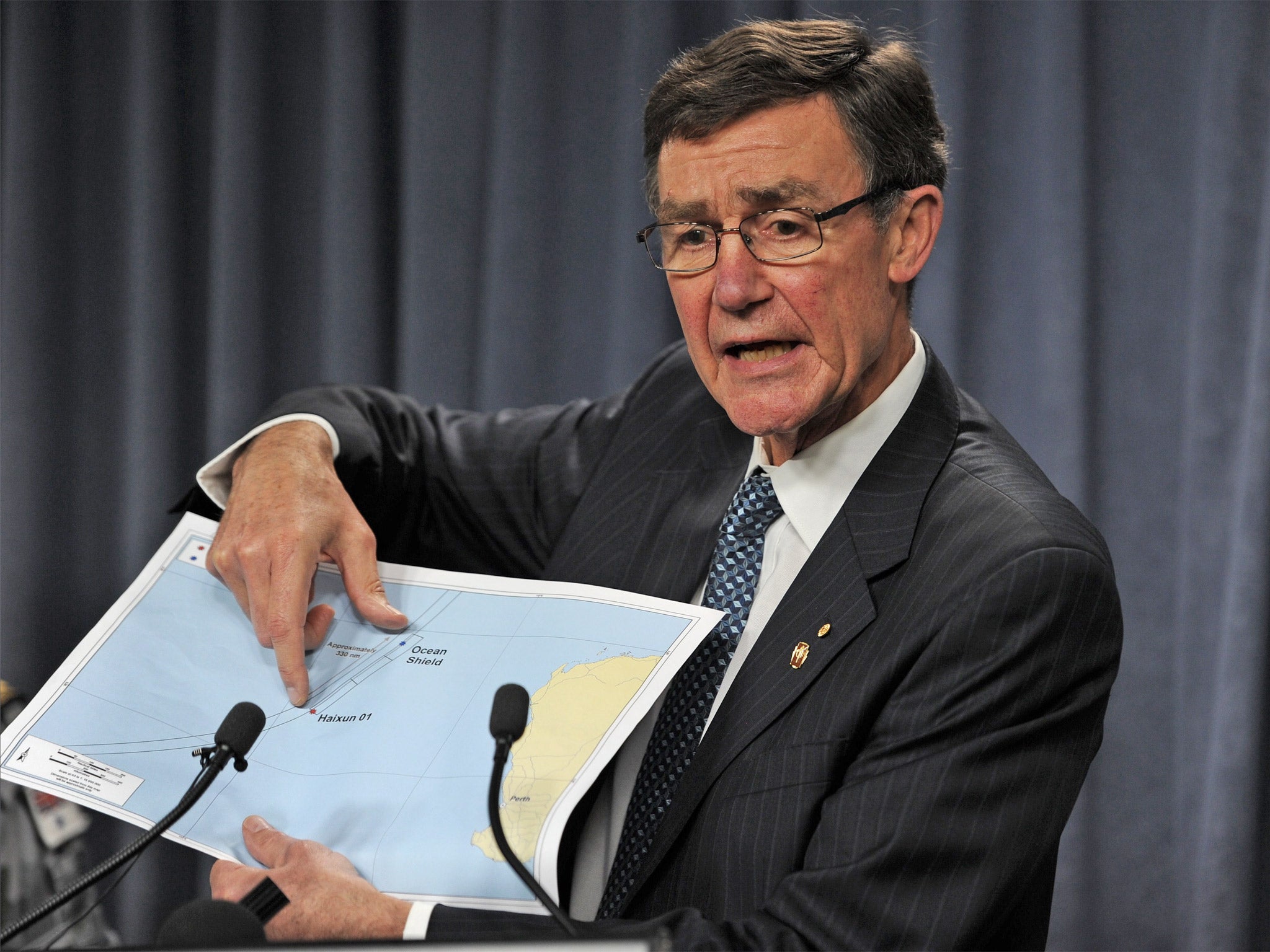
I saw Angus Houston’s press conference this morning and the subsequent discussion with analysts and experts on a popular international TV channel. I didn’t see it all, as what I was hearing left me deeply disturbed.
Listening to the commentary and analysis, it appeared as if Australia could do no wrong, and the unstated seemed to suggest that Malaysia could do nothing right. There was much relief and a congratulatory air all around that a ‘lot of information was forthcoming’ (finally?).
Yet, when I recall Houston’s address and his responses to the questions that followed, I can’t say that I heard anything significantly different by way of comparison to Malaysian efforts.
The essence of what he said (as I have received it) was that:
- The search process is dynamic and that things change;
- Satellite data is being ‘corrected’ to narrow down the search area;
- Acoustic events reported are being investigated, that such verification and confirmation take time, and speculations are not desirable;
- Movement of relevant ships to areas of interest are matters of days and therefore the tasks are painstaking and time consuming;
- The deep sea, including the depth, poses huge challenges;
- The meeting with the Chinese ambassador the previous night helped iron out details of how coordination will proceed; and
- There is the reality that there are journalists on board the Search vessels and that premature information leaks are to be expected.
The very same points made by a Malaysian minister has at various times been described as evasive, contradictory, withholding, lacking in a sense of urgency, unconvincing, uncoordinated, unprofessional and incompetent.
One suspects that we are inherently willing to be trusting of the Australians, more patient and generous in our assessment of their handling of the search and rescue (SAR) so far, and ‘see’ more being put out. We are willing to be readily forgiving of the Australian prime minister who ran to Parliament in a rush of overenthusiastic competitive populism perhaps to announce ‘sightings’ before they were verified, but unforgiving of his Malaysian counterpart who announced the end of MH370 based on ‘expert opinion’ (Inmarsat and the British Agency). Abbott was subsequently even characterised as statesmanly when he retraced his steps and advised caution in jumping to conclusions, and by committing his country more fully to the search effort!
While the wait for news of MH370 and Chandrika stretches on, television programming such as what I have seen this morning leaves me perplexed about what else is at play at individual and collective levels.
For instance, can we see that it is inevitable or inherent in the situation that we will be deeply suspicious of the Malaysians handling of the event, given that they have responsibility, and liability. Quite expectedly, some may say, they have a vested interest in being economical with the truth, in disowning gaps and lapses, concealment and in deflecting criticism or responsibility.
Australia, on the other hand, if freed of the burdens of ultimate responsibility or even liability, has everything to gain from this event by way of goodwill. Do we see that Australia has entered the scene as a critical player in the ‘search and rescue’ much after the highs and lows of raised hopes and hopeless despair generated by the sighting of debris in the weeks preceding? That they are building on a platform that has been created by the Malaysian led effort of the past month, in the midst of intense scrutiny, and trenchant criticism. Do we see that the announcement of the ‘acoustic events’ themselves have a way of favourably shaping the perception of the messenger, since it is in line with the announcement that we so wish to hear?
The Chinese doing their own thing and not being subject to superintending control of a Malaysia-headed task force would have been intolerable. With the Australians in command, we are willing to take their (Chinese) ways as things to work around, glossing over the fact that the Chinese perhaps ignored propriety/protocol, and released information on signals picked up directly to the press (and the world at large) rather than through Australia after due verification. Leaks in the past were presented as a consequence of the Malaysians’ frugality in information sharing. Now we are quite willing to settle for an explanation that journalists on board search vessels will do their thing (jump the process, leak), and that is reality.
I wonder if all of this has something to do with cultural affinity (vis-à-vis Australia), prejudice vis-à-vis less developed countries (poor = dumb?), amplified racial suspicions, smug arrogance of the new empire, and harsh judgment of those that are not fully techno-able, amenable or subservient. Quite likely that all this is is unconscious, and not deliberate. It is quite possible that my own deep post-colonial apprehensions of Western hegemony makes me hyper-sensitive to the extremes of condemnation or hyperbolic approbation, and I read too much into things quite innocuous.
I bring this up at a delicate time when media attention, scrutiny and support matters one hell of a lot. I don’t hold a brief for Malaysia. I do believe that they have much to answer for, and there will be time for that too. I have a personal stake in the search for MH370. I only hope that the same scepticism and relentlessness be deployed in the current phase of the SAR that the previous weeks have seen. That is our only guarantee that truth will prevail.
Image: The Independent
This post originally appeared on Facebook.
Leave a reply